
Sep 28 2012

Word of God Speak?

“And if we’re going to be faithful to scripture, we must learn to love it for what it is, not what we want it to be.” Rachel Held Evans

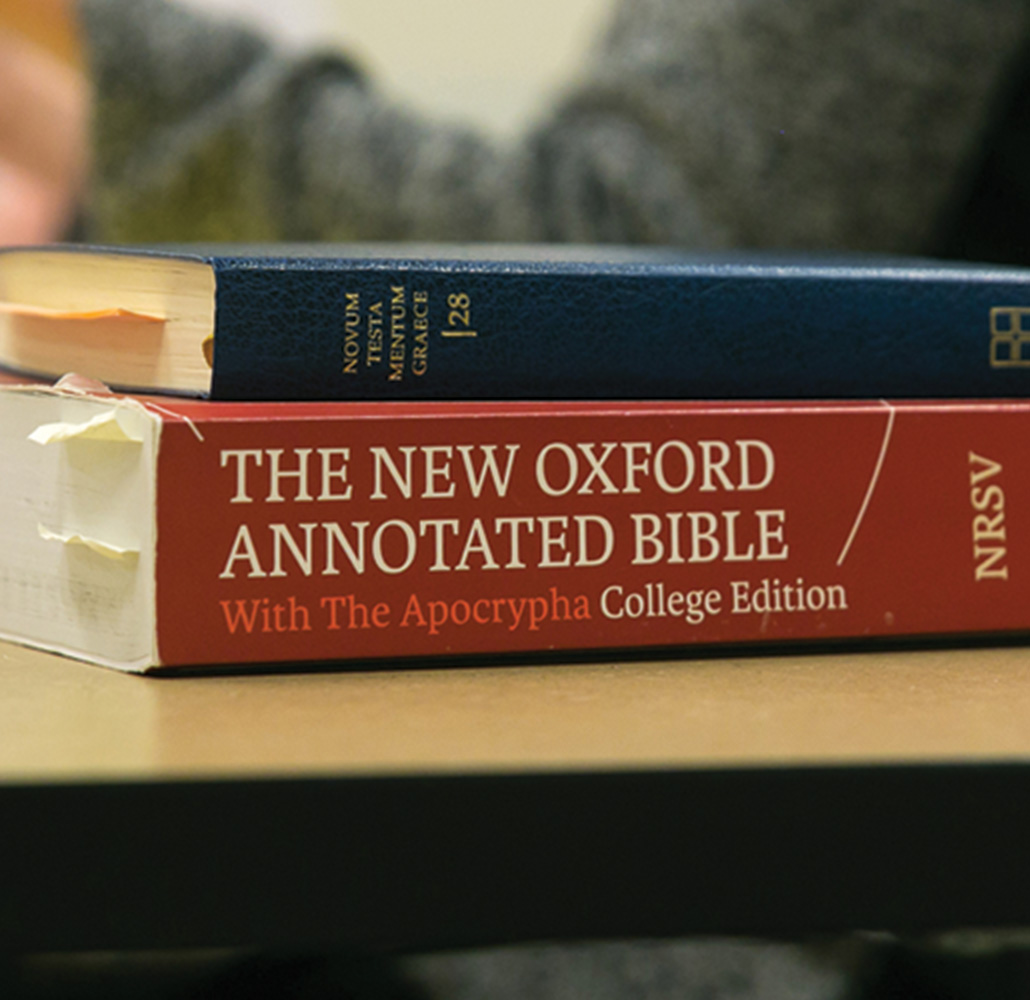
Jennifer ReadingThis might seem like an obvious statement for a seminarian to make, but I think about the Bible a lot. So much so that for a long time, the Bible had been mentally reduced to a seminary textbook which  I lugged begrudgingly  from class to class. After all, I have spent the last few years reading, exegeting, parsing, translating, exploring, preaching from, wrestling with and sometimes almost drowning in the Scriptures. And I should tell you that it is hard to love something when it’s your homework assignment.

But lately, I’ve noticed that the Bible has snuck up on me again.

Because I used to think that I understood the Bible (after all, I was the 8th grade Bible champion back in 2001). But in many ways that Bible I understood was so flat and I thought I had figured it out. I used to think I loved the Bible but I think in many ways, I had no idea what that even meant.

But now I spend my lazy Saturday afternoons with my Greek New Testament flipped open to Romans with multiple commentaries scattered around my kitchen table and I fall asleep at night thinking about Genesis creation stories and what they mean.  I struggle with the Bible all the time. I fight with it. I want it to say what I think it should say and when it doesn’t, I want to pretend that it does anyway.

It confuses me, because I don’t know what to do with Joshua…or Daniel and I certainly don’t know what to do with that story where Elijah has two bears eat all those children.

It overwhelms me, and I don’t know what to think about it. Because the claims it is making are too expansive for me to grasp.  So I just stop. I move on to Kierkegaard or Barth, but they never let me stay away for long. Before I know it, I’m back in Romans wondering what exactly Paul means when he talks about the righteousness of God.

But it also still finds ways to inspire me, like when I stumble upon verses in Jeremiah that say: “

Thus says the Lord: Stand at the crossroads, and look, and ask for the ancient paths, where the good way lies; and walk in it, and find rest for your souls.” (Jeremiah 6:16)

And in all this struggle, I am beginning to see that the Bible is deeper than I ever imagined. It is more complex and beautiful that I ever gave it credit for being.  And now as I read it, I hear the different voices that speak out across the generations to tell me something about what it means to be a Child of God, and about who that God is. As Barbara Brown Taylor puts it in her book, The Preaching Life:

“[Because of the Bible] I am not an orphan. I have a community, a history, a future, a God. The Bible is my birth certificate and my family tree, but it is more: it is the living vein that connects me to my Maker, pumping me the stories I need to know about who we have been to one another from the beginning of time, and who we are now, and who we shall be when time is no more.”

It is a testament to who God is, and just like God, it is too intricate to be condensed into devotional or even a textbook. And so, I’m learning how to love the Bible again, learning how to love it for it is in its entirety and not just love the pieces that fit into my little ideas about God and God’s people.

And I’m learning what it means to say that this book is the Word of God for the people of God.

Thanks be to God.

-Jennifer Wyant

Jennifer is a third year MDiv student from Atlanta and a Student Ambassador.


Sep 21 2012

Don’t Drag Your Buffalo

We made the move from St. Louis to Atlanta so fast.   We made the decision to come to Candler in May, and eight weeks later we were on I-24 with our entire lives packed into strategically-placed cardboard boxes.   We hardly thought about how much our lives were going to change.   Both of us were changing paths, and one of us was changing careers completely.   We were now going to be living on one income instead of two.   We had no friends here.    For the first time, we had no family remotely close to us.   We underestimated the struggle of living by two completely different schedules.   We just didn’t think about all the things we were giving up, until our car died.   That car was a part of our lives.   Our lives in St. Louis depended on us being able to go our separate ways.  If we needed to do two things at once, we could.  It was my car since high school.   It just always existed in our eyes.

The first leg of the move to Atlanta was ridiculous, even funny.   Two hours into the trip, the AC went out in one of the cars.   The choice was between driving my dad’s F-150 through the mountains (which was being fully realized with a U-Haul trailer hitched to the back), or driving a car without AC in the midst of intense July heat.   Needless to say, we decided to stop in the middle of Tennessee and stay the night.   We got up the next morning thinking we were going to start up the car and move to Atlanta, and it just didn’t happen.  The car did not start.  We finagled it in every way.  It wasn’t a battery problem, it wasn’t an electrical problem—it was a legitimate issue.   It was clear that it wasn’t going anywhere, and it sounded awful.   We called a tow truck.   Ryan sat at a mechanic’s shop in the middle of Tennessee for 4 hours.  My mom and I killed time in Target picking up those random items that go missing when you decide to pack up your life and move it somewhere new.   They took the car apart, and put it back together.   It still wouldn’t start.  We waited, and waited, and waited.  We tried really hard to save it.  We didn’t want to let it go.  They finally broke down and said it was hopeless.   The decision was between putting a new engine in it or burying it right then and there.  It was like what happens on the Oregon Trail.  When your buffalo drowns, you don’t drag it the rest of the way.  You just leave it there.  One thing was clear: our buffalo had drowned.

We took a hard look at the situation, and decided to bury our car in Murfreesboro, Tennessee.   RIP, Dodge Stratus.   When Ryan made the call to tell me about the car, I broke down in the middle of Target.   I was that girl you saw losing it in the Housewares Department.   At that point, it hit me.   I realized we were giving up much more than we had originally thought; we had taken things for granted.   After we buried our car, we went on with the move to Atlanta.   It seemed odd leaving what was such a valuable part of our lives behind in a random town.   We had seriously lost something we had taken for granted, and it clued us in to what was actually going on in our lives.

I tell this story to remind us that something will be lost along the way.  Deep friendships are not instantaneous.   Family interactions are left only to phone calls.   A church home is not easily replaced.   Changing paths sometimes means living on less.   And you don’t become good at being a one car family quickly.   What Ryan and I have learned as a result might be one of the most grace-filled lessons of our lives.   It has been a lesson in living a life that involves sacrifice, and as a result, sometimes need.   We’ve learned that we do not live lives apart from community.   We needed friendships and a church family.   But we had to be realistic about our material needs, too.   We needed scholarships, loans, and support to afford seminary and a move across several states.   We had to humble ourselves enough to accept the generosity of others.   But we also had to be observant and responsive to abundances that would arise in our own lives, and we had to learn to practice generosity to those around us.

The result of dramatic changes in our lives in order to make it to this new place has been a rewarding experience.   It was definitely worth losing a car, amongst other things.   We have been blessed here in so many ways.   Though friendships were not immediate, we have found those with whom we feel deeply connected.   Though we are away from our families, our appreciation for our time with them has increased rapidly.   Though we left a loving church family, we have been able to be a lasting part of a brand new church in a totally different setting.   We were thrown into so many changes that we didn’t quite expect, but we were sustained and supported, and we have learned great things.   Our sacrifice has been richly rewarded, and we are so thankful.

 - Ashley Kirk

 Ashley is a second year MDiv student from St. Louis, MO.


Sep 5 2012

If Only To Be, More Fully

Mat and students at Wesley Resource CenterWhen I am asked the question, “What did you do this summer?” most people laugh when I reply, “I served churches in the Bahamas.” They want to know how the beaches were (pristine) and the water (crystal clear), but those topics only have so much depth. Pastoring in paradise presents challenges to the budding minister on all fronts. This summer I worked with Rev. John Baldwin 09T 10T, overseeing five churches on three different islands, building a Family Resource Center with the help of youth mission teams, and being present in the five different communities we served. I learned that with the right outlook and the proper orientation, one begins to see how God has been moving and is moving throughout a community.

Before coming to the Bahamas, I had had nominal experience with the Black church. I knew that this would be a difficult transition—which it certainly was—but I had no idea that it would be so transformative.

In the first week I preached three times, led a bible study, tore out a wall in our house (intentionally), and attended the funeral for a matriarch of the community. The quick pace forced me to keep up. I thought to myself, “When do I get a Sabbath rest?” Ha! I soon realized that you can take a break, but when you come back, the action has not slowed down, only become backlogged.

I learned the meaning of “concentrated rest.” In what will be the first of two plugs for Dr. Gregory Ellison II, Dr. Ellison preached a sermon last year around midterms. With the papers due and the exams approaching, taking a Sabbath would have been both wise and unrealistic. So Dr. Ellison instead encouraged us to take “concentrated rest.” To take time where you focus on your health—spiritually, emotionally, physically—knowing that that period of rest will be short-lived. While I could not take a full day off in the Bahamas, I learned to practice “concentrated rest” in my morning and evening time. Mornings became a time of preparation, not requiring much energy, but rather like the sprinter pausing on the blocks before the sound of the gun. Likewise, my evenings became a time of rest as John and I debriefed on our day.

This personal transformation in my private life began manifesting in my public life. My practices of rest at home gave me energy and clear vision when I went out into community. Dr. Ellison said in Pastoral Care, “Once you see, you cannot not see.” My eyes began opening to the unique needs within the communities I served.

I saw that young children needed safe places where they could come to get away from abusive or unsafe home lives. The Family Resource Center will go a long way towards addressing those issues, but in the time leading up to its completion, I knew that I needed to be present among the youth and children in the community who had few advocates. In response, John and I opened our house to any kid who needed a place to escape. We also went around the community often checking in on the children and youth. As the future of the community, they need care and support.

It is often said, “Ministry occurs often at the intersection of the head and the heart.” I want to suggest that ministry comes alive as the pastor becomes a more fully integrated, authentic person. As my hands, head, heart, eyes, and ears all begin working together, I began to open myself up to a community, able to bring my whole self to serve them.

- Mat Hotho

Mat is a second year MDiv student and a graduate of Florida Southern College.  He served as this year’s Bahamas Summer Intern – a program that sends a Candler student to the Bahamas Annual Conference each summer.


Aug 27 2012

From Educator to Educated

As my first year at Candler begins I recognize that I am about to enter a world very different from that where I have been living.  For the past three years, I taught Algebra 1 in the Arkansas Delta through a program called Teach for America. TFA places folks like me in low-income schools where students are traditionally not performing on grade level. The program charges recent college graduates with the task of motivating and galvanizing students and other teachers at their particular placement school with the goal to chip away at the achievement gap that exists between low-income and high-income schools in our nation.  While the Delta may be far from Atlanta in many ways, what I’ve seen, learned, and experienced teaching in Helena will likely inform the my forthcoming study of theology.  I’ve found a couple.

#1 – Character

“Learning is hard. True, learning is fun, exhilarating and gratifying — but it is also often daunting, exhausting and sometimes discouraging. . . . To help chronically low-performing but intelligent students, educators and parents must first recognize that character is at least as important as intellect.”

This comes from a New York Times article  that discusses how Dave Levin, co- founder of a the KIPP charter school network, partnered with the headmaster of a top-tiered NYC private school in seeking to teach students character. School in the KIPP network typically operate in low-income communities, working towards similar goals as Teacher for America. For the past year, I taught at a KIPP school in Helena and became more intimately familiar with this attempt to teach character. To fully internalize the weight of what the research has shown, go to the link and read it (heads up – its long) However – two key findings that this article speaks to that have given me insight into the overlap to which I previously alluded.

The article argues for teaching students character, not because of the moral preference of those in administration, but for very practical reasons. Martin Seligman, a psychology professor at the University of Pennsylvania, refers to the importance of such teaching citing, “The true importance did not come from the relationship to any system of ethics or moral laws but from the practical benefit: cultivating these strengths represented a reliable path to ‘the good life,’ a life that was not just happy but also meaningful and fulfilling.”

“I have come that they may have life and have it to the more abundantly.” -John 10:10. For the past three years, I’ve attempted to at some point speak some semblance of meaningful, fulfilling, and life strengthening values into my student’s lives. KIPP calls it character, Jesus called it life abundantly.

Whether I’m seeking to communicate character/ life abundant with students in a classroom, parishioners in church, orphans, seekers, deadbeats, burned out sinners, halo wearing saints, or self-righteous pietists, the hope of finding traces of such character and life remains constant regardless of the setting.

Levin and his counterpart seek to teach a general set of acquired traits referred to as “character.” Moving from the general to a specific trait led me to overlap number two.

#2 – Failure.

Failure is that which we seek to avoid at all costs. It is that which consumes so much of our time, worry, dread, anxiety, and stress.

For the past three years, I have been taught that this word is as fowl as its alliterative counterpart. Through the best of intentions I have been indoctrinated in the belief that my student’s failure was my failure. Failure was not an option. When only 8% of students in low-income families are graduating from college, failure is not an option. 8% is not ok.

Here’s the problem.

KIPP students at Auburn University“We thought, O.K., our first class was the fifth-highest-performing class in all of New York City,” (Dave) Levin said. “We got 90 percent into private and parochial schools. It’s all going to be solved. But it wasn’t.” Almost every member of the cohort did make it through high school, and more than 80 percent of them enrolled in college. But then the mountain grew steeper, and every few weeks, it seemed, Levin got word of another student who decided to drop out. According to a report that KIPP issued last spring, only 33 percent of students who graduated from a KIPP middle school 10 or more years ago have graduated from a four-year college.”

As the article continues, it explores the notion that IQ and high test scores were not what was shown to be correlated with success in college. What did correlate, however, was grit – perseverance through failure. In true KIPP fashion, the network has taken to quantifying grit through a “Grit Scale” self-assessment that requires you to rate yourself on just 12 questions, from “I finish whatever I begin” to “I often set a goal but later choose to pursue a different one.” The “Grit Scale” has shown to be “remarkably predictive of success” according Penn Ph.D. graduate Angela Duckworth whose field test yielded the predictive data.

Grit moves us from failure to victory.

“Many of us are haunted by our failure to have done with our lives what we longed to accomplish. The disparity between our ideal self and our real self, the grim specter of past infidelities, the awareness that I am not living what I believe, the relentless pressure of conformity, and the nostalgia for lost innocence reinforces a nagging sense of existential guilt: I have failed. This is the cross we never expected, and the one we find hardest to bear.” -Brennan Manning

We’ve got to rethink our notion of failure and how we deal with it. In the world of education in which I was blessed to be a part, we’ve lost sight of how to teach kids that failure is inevitable and one of our greatest chances to learn and move forward. Instead, we fill students’ heads with facts and expect them to regurgitate them on tests that have been deemed important by a source that is not intimately connected to our students in our classrooms. Students cannot develop grit without experiencing failure.

In the church, we’ve lost sight of a God who is intimately connected with our shortcomings. We’ve forgotten the story of the prodigal son, whose unspeakably deep failure and missteps didn’t stop the father from running to meet his wayward son before the son could even speak one word of penitence. “While he was still a long way off, his father saw him and was moved with compassion. He ran to the boy, clasped him in his arms and hands and kissed him tenderly.” -Luke 15:20 The son failed, came back broken, and was granted forgiveness before he even could ask. Failure has never been a deal breaker for the Father.

“The person with depth is the one who has failed, learned to live with it, and continued to move forward.” – Brennan Manning

Failure will come. If we are to keep growing, we must keep risking failure throughout our lives and learning to mature out of what the failure has taught us. We can’t keep running away from failure in education or in our relationship with our Creator.

“Success is not final, failure is not fatal: it is the courage to continue that counts.” -Winston Churchill

May I remember these lessons as I embark on a new journey at Candler.  May we all seek the character that comes from pursuing an abundant life and learn to live in a way that embraces the idea that only through learning from failure may we be propelled into greatness.

- Levi Rogers

 Levi is an entering MDiv student.  He spent three years teaching in the Arkansas Delta and is a graduate of Auburn University.


Aug 21 2012

Lessons Learned

This summer 14 Candler students are serving in ministry through Candler Advantage, a paid summer internship in conjunction with Candler’s Contextual Education Program.  Over the course of the summer many of these students will be sharing their experiences here on the blog.

Candler students are privileged to have various internship opportunities during their time at Candler. I gratefully had the opportunity to participate in the Candler Advantage program this summer. My site was Wesley UMC in Charlotte, North Carolina. It will be an unforgettable experience for the rest of my life.

Jaeyong Hard at WorkAll ministries that I experienced at Wesley were meaningful and precious for me, such as Vacation Bible School, the Youth Mission Trip, several community events, and many visitations. However, leading a Bible study with members of the congregation brought me several life-changing questions.  At first, I heard that church members were excited to have a seminary student as a Bible study leader and expected to learn some recent theology. Therefore, I chose Walter Brueggemann’s“The Prophetic Imagination” as the subject of our study.

However, once we began several members told me that the Bible Study was not easy and a little uncomfortable for them. And, I agreed. So, I changed course and tried to figure out why we felt uneasy with the subject. The main reason is that the book talks about an image of God different from the image of God we usually think of.  To make it even more complicated, all of us have our own image of God we have formed throughout our lives.  Whether we come from conservative backgrounds or liberal backgrounds, each person has images of God accordingly. It is very natural to have an image of God according to one’s own backgrounds and characteristics.

However, the problem is the fact that we do not make an effort to expand our image of God – to enlarge our understanding of God.  Think about it.  How much do we know about God?  We are mere creatures on earth, and God is the Creator God.  What we know about God is probably like a grain of sand on a sandy beach.  With a small basket, we cannot scoop up the whole ocean.  With our small heads and with our small understanding, we cannot understand God fully.  Therefore, we should make an effort to learn about God more deeply and more broadly.

As the group continued together we found that the books of the Prophets that we covered in the Bible Study are barely taught and preached at church. How about Lamentations? Today’s Christians hardly read Lamentations. Lamentations is not shared in the church because we do not know what to do with the depressing passages; they do not fit contemporary Christians’ images of God. However those books are in the Bible and give us significant lessons to us for our faith journey, so we need to read, study, and understand them.

The Bible study at Wesley brought me several questions. First, do I keep making an effort to broaden my image of God, and do we keep making an effort to deepen our understanding of God? After all, the Bible says, “I God desires the knowledge of God more than offerings [mere worship service] (Hosea 6:6), so it seems important to do so.

With one of many host familiesThe second set of eye-opening questions came from living away from my home and living in others’ houses. During my 2 and half months in Charlotte, I moved almost every two weeks because the church couldn’t afford to provide lodging for 10 weeks. So, five church members hosted me and my family. My wife, baby and I really appreciated the host families for their generosity and hospitality. However, moving every two weeks was not easy. It was not easy to pack and unpack again and again 10weeks’ worth of baggage. Moreover, the baby’s baggage was bigger than we expected. It was not easy to move while taking care of Amy, my baby.

However, this moving every two weeks opened my eyes to think again about my life and our lives here on earth. Where is my real home? In Charlotte, North Carolina? Of course not. Atlanta, Georgia? No, I just pay rent every month. Seoul, South Korea where I originally came from? No, I don’t have any home there because my wife and I came to United State right after our marriage. My home is not here on earth. Most people live here on earth with their own houses. People who do not own their houses yet do their best to have their own ones. Even many people who already have their houses continually try to find bigger and better ones. We keep trying to settle in our houses. In fact, however, the houses in which we are living here on earth are not our homes.

The houses I have stayed in for ten weeks in Charlotte have not been my homes because I just stayed there for 2 weeks at a time for my internship, for my calling. Likewise, the houses we are living here on earth are not our eternal homes. We all are only staying here on earth for our calling. After I finished my calling there in Charlotte, I came back home to Atlanta. Likewise, after we finish our calling here on earth, we will come back our eternal home, Heaven. We live here on earth for 70 years, 80 years, or 100 years. However, compared to the eternal time in Heaven, those few years here on earth are like the 10 weeks of my internship.

Yes, I am a traveler here on earth, walking toward, coming back toward Heaven.  Then, how does my life look like?  Do I really live here on earth as ones who have their eternal home in Heaven?  Or do I live here on earth as if I will live here for-ever?  Do we often think about Heaven?  Or do we spend most time to think about here on earth?  And of course, how do we think about God?  These questions that I had from this summer internship will resonate throughout my life. Again, I am very grateful for Candler Advantage program and strongly recommend this opportunity to all colleagues.

- J.Y. (Jaeyong) Song, M.Div.

Jaeyong Song is a rising third year MDiv student from Seoul, South Korea and a traveler here on earth.


Aug 13 2012

Who am I to do this work?

“I’ve been hiding with this whole Battlestar Galactica thing,” I told my husband in an emotional heart to heart recently. It was the most shameful confession I’ve made in a long time. Not that there is anything wrong with the science fiction drama that’s been infiltrating the lives of countless hipsters of late. It wasn’t Battlestar Galatica’s fault. No, I can’t blame this one on Starbuck and Adama.

When I found out I was accepted to divinity school and made the decision to attend Candler, I was thrilled. That excitement carried me right through my wedding in May, the honeymoon, the squeaky newness of our marriage, and the lofty dreams of the next three years together. Life just kept getting better. Hooray! When the summer began, I had plans to read devotionally, work on my prayer life, and make my way through James Kugel’s How to Read the Bible all before setting foot on Emory’s immaculate campus. Instead, this summer I’ve allowed my free time to be taken over by Cylon invasions and intergalactic love triangles. How did that happen?

One of the best things about being married is having someone you love and trust tell you when you’re full of sh*t. I’ve been blessed to recently discover this overlooked benefit. My husband told me in the midst of a disagreement, in which I was being completely irrational, “I have disappointments too, Anna. Don’t take this the wrong way, but I’m disappointed in how little time you’ve spent preparing for Candler in your reading life.” It was like staring at myself in the mirror, and then realizing that I actually look like crap. And that’s when I confessed to the abuse of Battlestar Galactica – my inconspicuous drug of choice.

Now some of you reading may think I am blowing this all out of proportion. There is nothing wrong with Battlestar Galactica! Nothing wrong with spending your summer indulging in vices soon to be off limits when studies begin! And you would be right. But for me, choosing evenings with Battlestar Galactica over evenings with Kugel, with the Bible, and with God, meant that I was avoiding facing my own anxiety and fears about starting divinity school.

In one of the Candler information sessions I attended, Mary Lou Boice, Associate Dean of Admissions and Financial Aid, said something particularly profound. She said something along the lines of, “It takes a lot of guts to say you want to be a pastor, to overcome the question of, ‘Who am I to do this work?’” And she couldn’t be more right. When the wedding faded into the past, and I had only divinity school to look forward to – I began to fear what this new life would be. Who am I to do this work? I just recently became a Christian. I’ve had people read my blog and compare me to Dante’s Lucifer. I don’t know any of the party lines and denominational platforms. Who am I? I’m going to Candler and I don’t know anything about John Wesley! I was raised Unitarian in a humanist household. I barely know how to pray. My Christology is in flux. Who am I but just another lost sheep? Who am I to guide anyone to the Shepherd?

I’m just another child of God. That’s who I am, and it’s the hardest truth to reconcile. Maybe it’s the sheep who have once been lost who are best able to lead. Or maybe not. The truth is that going to divinity school is the biggest leap of faith I have taken. It’s the beginning of a not-my-will-but-thine life. Because I don’t know how God will use me to minister. I don’t know how God will work through me. But I have made a decision to give my life to be used for that purpose. And all I can do is try my best to be ready. All I can do is have the audacity to trust.

Now, pass me that remote. I’ve just got 3 more episodes to go before I finish Battlestar and begin the rest of my life.

Anna Flowers is an entering MDiv student. She has a degree in English Literature from the University of Chicago and currently lives in Atlanta, GA with her husband and cat.


Aug 6 2012

(Trans)Forming our vocations!

This summer 14 Candler students are serving in ministry through Candler Advantage, a paid summer internship in conjunction with Candler’s Contextual Education Program.  Over the course of the summer many of these students will be sharing their experiences here on the blog.

My official work has already come to an end, but there is so much to share about my summer as a Candler Advantage intern.  Along with many other possibilities, it allowed me to have an opportunity for more intensive formation/transformation in the practice of parish ministry. During this summer, I served Sunlin Methodist Church in Incheon, South Korea. My original proposal focused on forming/transforming Sunlin youth group’s vocational imagination.

Demonstration with Comfort Women

Sunlin youth at the Wednesday demonstration

At Candler, I took a class titled Religious Education as Formation and Transformation. In this class, I particularly engaged in Dr. Katherine Turpin’s book Branded. This book deals with an issue of adolescent’s vocation in consumer culture. She defines current consumer culture as a kind of religious system, because it forges purpose and meaning in people’s daily lives. She points out that the consumer culture devastates adolescents’ vocations; the adolescents equate their purpose of life with possessing enough money to purchase the right branded goods.

This book made me think of my original context in South Korea. I analyzed the SAT system in South Korea as a faith system for Korean adolescents. Like the consumerism in America, high school students’ lives in South Korea are almost organized around the national college entrance exam – Soo Neung. Korean adolescents’ vocational imaginations are also devastated by this faith system; they equate their purpose in life with getting a high score on the Soo Neung and admission into a prestigious university so that they may lead successful lives.

Through Candler Advantage, I set out to shape Korean adolescents’ vocations – leading a gradual shift (or transformation) from their devotion to the Korean standardized testing system to genuine Christianity. In order to engage in a ministry for the issue of vocation, I chose  Sunlin Methodist Church as my Candler Advantage Internship site. During the ten weeks of the Candler Advantage program , I have tried to combine what I theoretically learned at Candler with what I practically do at Sunlin. For (trans)forming the Sunlin Youth group member’s vocation, I designed/supported various approaches – sermons, field works, a retreat.

In the first sermon, I challenged Sunlin youth members to realize their devotion to the Korean SAT system as their faith system, and I invited them to the journey to form/transform their genuine vacations from God. In the second sermon, I explained some crucial features of Christian vocation and suggested them to be good Samaritans (or good neighbors) with marginalized people in our society as a communal vocation at Sunlin Methodist Church (Actually, the Korean term Sunlin means a good neighbor, which is based on the parable of a good Samaritan in Luke).

Won Chul with the Sunlin youth in the War and Women’s Human Right Museum

Then, I designed an educational program to encourage the youth group to be good neighbors in our society: “Becoming Sunlin: Sunling Camp, Joy From WITH.” In this program, we visited “The War and Women’s Human Right Museum” so that we carefully listen to stories of women whose human rights have been violated by wars and sincerely understand their pain and suffering. Specifically, this museum is an open space to remember ‘comfort women’ who were forced into sexual slavery by the Japanese military during World War II and now are marginalized women in Korea. After visiting the museum (understanding the pain/suffering of ‘comfort women’), with comfort women, our youth members directly participated in a Wednesday Demonstration to seek sincere apology and appropriate reparation from the Japanese government (The Japanese government denied that they did not force them into sexual slavery; they voluntarily chose to be a prostitute or some private organizations, not the government, forced them into sexual slavery). From the reflection times after the program, some youth group members realized Joy, importance, and power of “WITH” – having solidarity with the marginalized.


Covenant Group and Jesus Prayer

Won Chul’s covenant group during the retreat as he prepared the Jesus Prayer.

Finally, I supported the 3days Sunlin youth group’s retreat. Under the supervision of Rev. Gu Hyun Kwon, a senior pastor at Sunlin, we had an opportunity to take a rest both spiritually and physically. We formed covenant groups and each group practiced several methods of spiritual meditation and prayer instructed by Rev. Kwon: Jesus Prayer – breathing in while calling out to God (Lord Jesus Christ, Son of God) and breathing out while praying for mercy (have mercy on me, a sinner) and Lectio Divina – reading and contemplating the book of Jonah . These spiritual practices in calm nature allowed youth members to have a time of being free from their pressure and to think of their calling from God.

During this summer, my Candler Advantage Internship has (trans)formed my vocation as well as Sunlin youth member’s vocations. Through the Candler Advantage, I found a real possibility of my congregational leadership, and re-affirmed my vocational calling: academically seeking virtues (specifically, love and justice) of a Christian community and practically empowering a congregation to practice the Christian virtues.

- Won Chul Shin

Won Chul is a rising third year MDiv student.  He is president of the Candler Social Concerns Network and a graduate of Yonsei University in Soul, South Korea.


Jul 31 2012

Keeping it Simple

This summer 14 Candler students are serving in ministry through Candler Advantage, a paid summer internship in conjunction with Candler’s Contextual Education Program.  Over the course of the summer many of these students will be sharing their experiences here on the blog.


I’ve learned plenty this summer.

On time management:

Small groups in your home = big housecleaning crusades in your home. Think “Love and Marriage,” that corny old love song: you can’t have one without the other. Plan accordingly.

On communication:

The only things guaranteed in life are death, taxes and church people getting up in your business. When you find yourself in the line of fire, make like Jesus and doodle in the sand. A reactive response is a dangerous response: give it a solid 24.

On event-planning:

There are lots of people in your church who are really good at this. You, on the other hand, are a bit of a spaz. Put the talents of others to use. They want to help.

As my Candler Advantage Advanced Summer Internship comes to a close, I find myself reflecting on the countless lessons I’ve learned from this 10-week experience. While many of them have a practical application, many, too, have been lessons of the heart.

I’ve learned that most fulfilling moments in the church are, without fail, the simplest. When one’s calendar is spilling over with to-do lists, it’s easy to forget that all of these activities are merely avenues for an opening of the heart.

I’ve thought a lot about the “KISS principle” a lot this summer: “Keep It Simple, Stupid.” And I’ve actually made it my mantra for church work. For as much as we try to complicate the gospel, we’re working with a pretty straightforward message: Let your love be contagious.

I’m grateful for the many lessons I’ve learned this summer. But I’m even more grateful for the simple moments that this Candler Advantage opportunity has afforded me–the simple moments in which I have witnessed the transformative power of love.

Thanks be to God.

-Suzanne Ecklund

Suzanne is a rising third year MDiv student serving at Grace United Methodist Church in Atlanta, GA.


Jul 23 2012

Grace Dances Amidst Holy Chaos

This summer 14 Candler students are serving in ministry through Candler Advantage, a paid summer internship in conjunction with Candler’s Contextual Education Program.  Over the course of the summer many of these students will be sharing their experiences here on the blog.

Christopher Szarke at Haywood Street CongregationGrace dances amidst Holy Chaos.

This lesson doesn’t come naturally after previously embracing the structure of Roman Catholic religious life (Benedictine and Franciscan) and spending two years as the seminary intern in a calm Episcopal parish.   It has been the most challenging and freeing lesson of the ten-week Candler Advantage summer internship at Haywood Street Congregation, a United Methodist mission church that primarily ministers with homeless people in Asheville, North Carolina, population 85,000 people.   Pastor Brian Combs, a 2006 Candler graduate, founded the congregation three years ago and ministers with Co-Pastor Shannon Spencer.

Our motto is “Come as you are.”   This might mean not having showered for several days, being drunk or high, or without medication that keeps psychosis at bay.   Many members of our community have been asked to leave other churches, which is interpreted as rejection by God.    We understand that God embraces everyone and that we are called as Christians to embrace Jesus in our midst.   Each of us has our own brokenness and it’s better to err on the side of grace, leaving room for God to do the work that we cannot possibly accomplish on our own.

Grace dances amidst Holy Chaos.

The Welcome Table is a huge meal serving 275 to 455 people every Wednesday, followed by an optional worship service.   The choice for liturgy on Wednesday is intentional after receiving feedback that the opportunity to attend church in the middle of the week gives the strength to carry on through Sunday.   It’s a chance to encounter Jesus in the sacrament of communion, to be surrounded by community, and to gain support to remain sober another day.

A cross-section of Asheville is present at worship: business people, who may have hidden addictions to alcohol or prescription medications, and homeless people with addictions that society judges with less forgiveness; people who meet survival needs through prostitution; church grandmothers, youth groups, and formerly homeless people – including many veterans – who return to encourage our sisters and brothers along the journey.    I recognize God working through the congregation when a man is welcomed back after being incarcerated in the county jail.   We shake rattles in response to prayers and concerns of the people: hopes for housing, rejoicing at receiving housing for the first time in 22 years, remembering brothers and sisters who are not with us today because they are in jail or a hospital psychiatric unit or are recently deceased.

Sermons are conversational, with the pastor asking the congregation for responses to the Scripture reading.   Sometimes people are ramble on in response or are argumentative.   Somehow the pastor is able to affirm all of these voices and connect them back to Scripture and how this speaks to us today.

Grace dances amidst Holy Chaos.

I spend little time in an office, joining our congregation where they are throughout the week.   On Monday I am at a day center for homeless people, followed by serving lunch in Pritchard Park with Be Loved House (a nondenominational house church), where people ask for prayers about jobs, housing, or reconciliation with estranged family members.   I have joined Pastor Brian at the local shelter, staying overnight in the men’s dorm following a chapel service.    On Sundays I participate in liturgy at the Church of the Advocate, an Episcopal worshipping community that is primarily attended by homeless people.   Here communion extends beyond church walls.   Two of us leave the church and take communion to our sisters and brothers on the stairway, under the trees, and on the sidewalk.   I participate in two homeless advocacy groups; one promoting a Homeless Bill of Rights similar to the one recently passed in Rhode Island.   Members of Haywood Street Congregation gather once a month at Habitat for Humanity.   I am humbled by the people who work on homes for people while they themselves are sleeping by the river or in the shelter.

I lead the offertory by calling out to Haywood Street Congregation, “What does God love?”    They respond with shouts and shaking rattles, “A cheerful giver!”   I describe how each of us is called to share our blessings, whether it’s the gift of patience and kindness, or praying for each other, or sharing a few coins, or boiling three hundred eggs to pass out at the Welcome Table, or writing to our friends in jail, or gathering trash in the parking lot.   People write on the service bulletin about how they share, coming forward to put notes and coins in a basket.   I hold the basket above my head and pray for God to bless and multiply the offerings so they may continue the ministry of Jesus in our congregation and the larger community.

Grace dances amidst Holy Chaos.    The Incarnate Jesus is present with us each day and I remain in awe of this blessing.

– Christopher Szarke

Christopher Szarke, a rising third year M.Div. student in the Episcopal Studies and Faith and Health Certificate Programs, is currently in the discernment process with the Episcopal Diocese of Atlanta.


Jul 17 2012

A Vital Church

This summer 14 Candler students are serving in ministry through Candler Advantage, a paid summer internship in conjunction with Candler’s Contextual Education Program.  Over the course of the summer many of these students will be sharing their experiences here on the blog.

What’s a vital church in today’s world?

To me it’s a church that looks like the rest of society.  Our world has changed; we no longer live in communities where everyone looks just like us.  My life experiences tell me this is a good thing.  I am greatly enriched by the experiences, customs, traditions and backgrounds of all people that I have met in my life!  Our churches need this enrichment as well to be vital places of worship in today’s world.

This summer through the Candler Advantage program, I have been exploring what makes a church where everyone is welcome work.  Through my internship at Park Avenue UMC I am gaining valuable ministry experience, and I get to do it in my home conference, the Minnesota Annual Conference of the Methodist church.  This vibrant church is a place of acceptance where people are free to pray, sing and worship in a manner that meets each individual’s own needs for connecting with God.  There is a high percentage of laity involvement in the leadership of worship services, and there is intentionality in who leads each portion of the service.  Every service also includes a variety of types of music, which vary from week to week, to provide the opportunity for each parishioner to connect with God and the Holy Spirit during worship.  The service is a place where all are uplifted and this tone is conveyed throughout the worship service.

For one of my contributions I recently lead the evening prayer group.  In the spirit of the church, I wanted to think of a way to include the many different ways that people pray during this prayer time.  I chose a creation theme, and we began by experiencing small bowls of water and soil (earth).  As we stood together, I offered a meditation on these foundational elements of creation which I tied to scripture readings.  Then after sharing prayer requests, I began our prayer and invited those in the group who wanted to pray aloud for others in the group.  This offered an opportunity for many different prayer styles to be expressed.  I am discovering that I need to think broadly when I am planning worship, prayer groups, studies, etc. to include many different ways of responding to God’s presence.  I am also learning that this practice adds to the vitality of this church and emphasizes that everyone is welcome and appreciated.

Through these experiences I – and hopefully the church – are learning how to live together honoring each other.  Once we as a worshiping community live this way we can go out into our communities and honor each other every day in all that we do.  To me, the church then becomes a vibrant teacher of how to live together in our 21st century communities.

- Bonnie Buckley

Bonnie is a rising third year MDiv student from Minnesota.